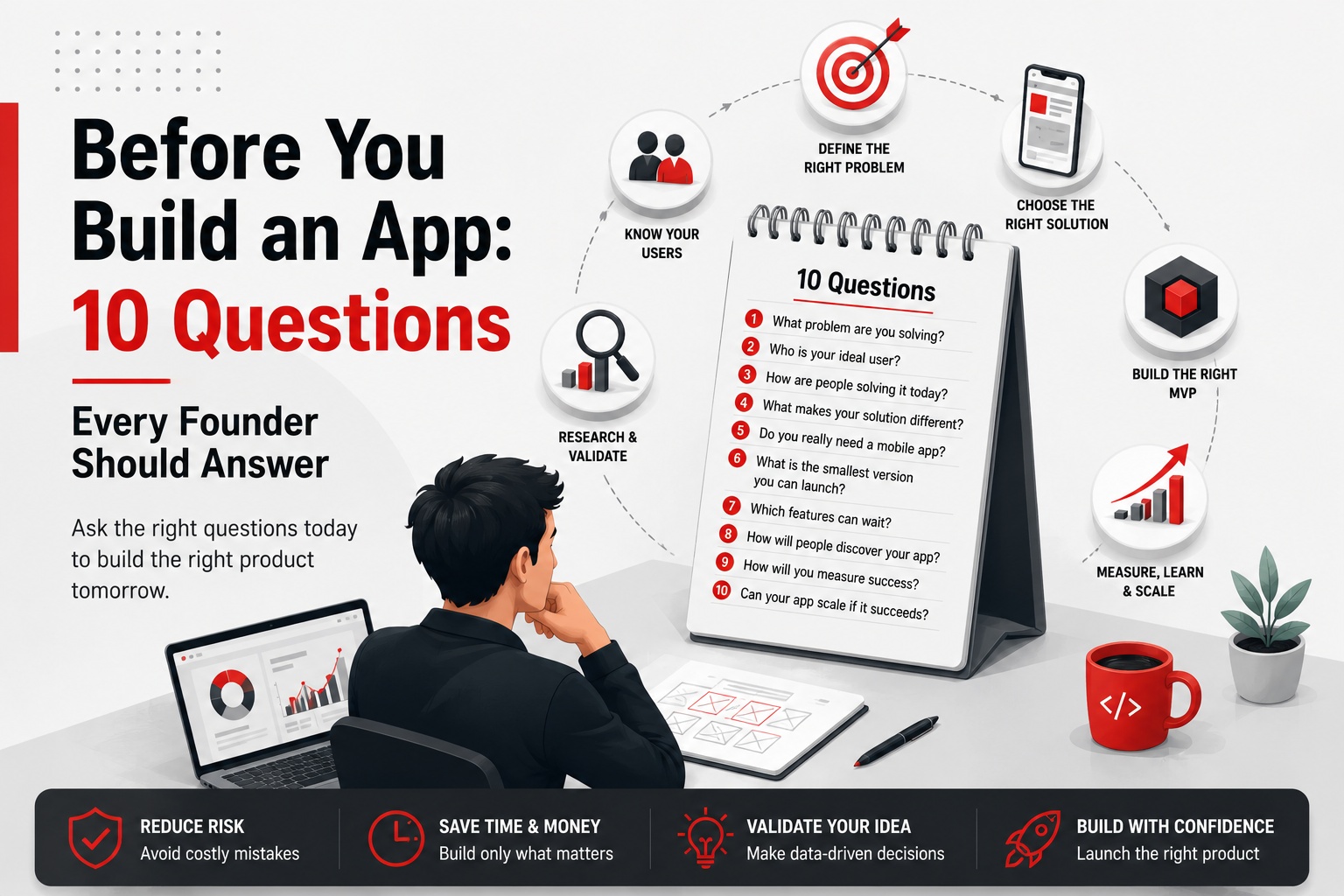
Before You Build an App: 10 Questions Every Founder Should Answer
You have an app idea. You've discussed it with friends. You've sketched a few screens. You've even started approaching software development companies for quotations. But before you invest your time, money, and energy into building an app, there's one important question to ask yourself: Are you building the right product- or are you simply building an idea? It may sound surprising, but many successful businesses never started with a great app. They started with a “clearly understood problem”. And that's exactly where many founders go wrong. They become excited about building before spending enough time understanding why they're building. The result? Months of development. Thousands of dollars invested. A polished product. But, very few users. This isn't because the developers failed. It's usually because the wrong questions weren't asked early enough. At Arodos Technologies, we've worked with founders, startups, and growing businesses across different industries. One pattern continues to repeat itself. The founders who spend more time asking questions before development almost always make better product decisions later. In this article, we'll walk through the ten questions every founder should answer before building an app. Whether you're creating a startup, digitising an existing business, or launching your first SaaS platform, these questions will help you build with confidence- and avoid some of the most expensive mistakes.
Why This Matters More Than Ever
Building an app has never been easier. Low-code platforms. AI-assisted development. Cross-platform frameworks. Cloud infrastructure. Today's technology allows products to be built faster than ever before. Ironically, this has created a new challenge. Because development has become easier, many founders start building far too early. The barrier to creating software has reduced. The barrier to creating a successful product has not. According to research by CB Insights, one of the biggest reasons startups fail isn't technology- it is building products that don't solve a meaningful market need. That's an important distinction. Technology rarely determines whether people use your app. Value does. And value begins long before development starts.
Building an App Is Easy. Building the Right App Is the Challenge!
Many founders assume the biggest challenge is choosing:
- Android or iOS
- Flutter or React Native
- Native or cross-platform
- Cloud provider
- AI integrations
Those decisions matter. But they're not the first decisions. Imagine building a beautiful restaurant in the middle of a desert. Excellent architecture. Beautiful interiors. Amazing kitchen. No customers. The restaurant isn't failing because of poor construction. It's failing because it was built in the wrong place. Apps work exactly the same way. Good development cannot compensate for poor product decisions. That's why the first phase of app development should never be coding. It should be thinking.
Question 1: What Problem Are You Actually Solving?
This sounds obvious. Yet it's where many founders struggle. When asked about their product, many people immediately begin describing features. "Our app has AI." "It has real-time notifications." "It includes dashboards." "It supports multiple languages." Those aren't problems. They're features. Instead, ask yourself: What frustrating, expensive, repetitive, or time-consuming problem exists today? For example: "We're building an app for restaurants." That's not the problem. A better definition would be: "Restaurant owners lose reservations because customers still rely on phone calls, creating delays and booking errors." Notice the difference? The second statement explains why the product should exist. A clear problem creates a clear product. A vague problem creates feature overload.
Question 2: Who Is Your Ideal User?
Not everyone is your customer. One of the biggest mistakes founders make is believing: "Our app is for everyone." Products built for everyone rarely resonate with anyone. Instead, identify your primary user. Be specific. Instead of saying: Small businesses Ask:
- Which industry?
- Which business size?
- Which job role?
- Which daily challenges?
- What motivates them?
- What frustrates them?
The more specific your audience becomes, the easier every product decision becomes. Everything from design to features to pricing becomes clearer. Companies like Airbnb didn't initially target every traveller. Uber didn't initially target every commuter. Slack wasn't designed for every organisation. Successful products often begin by solving one group's problem exceptionally well. Expansion comes later.
Question 3: How Are People Solving This Problem Today?
This is one of the most overlooked questions in product development. Many founders assume that if their idea is new, there is no competition. That's rarely true. People always have a way of solving problems. Even if they don't use software. They're using:
- Excel
- Phone calls
- Emails
- Sticky notes
- Whiteboards
- Existing apps
- Manual processes
Those are your competitors too. Understanding current behaviour tells you something incredibly valuable. It tells you what users are already willing to do. And more importantly- What they're tired of doing. For example, if businesses are maintaining five different spreadsheets every day, your opportunity isn't simply to build software. Your opportunity is to eliminate unnecessary effort. Products that remove friction are easier to adopt than products that simply introduce new technology.
Question 4: What Makes Your Solution Meaningfully Different?
This is not about being unique for the sake of being unique. It's about creating meaningful value. Ask yourself honestly: If someone already uses another solution, why would they switch to yours? Better design alone usually isn't enough. Neither is adding AI. Neither is adding more features. People change products when they experience:
- Better outcomes
- Simpler workflows
- Faster results
- Lower costs
- Greater convenience
- Better user experience
Think about some of the products you use every day. Most didn't invent entirely new categories. They simply made existing experiences significantly better. Your differentiation doesn't need to be revolutionary. It needs to be valuable.
Question 5: Do You Actually Need a Mobile App?
This question surprises many founders. Because sometimes- You don't. Not every business problem requires a mobile application. Sometimes the better solution is:
- A web application
- An internal business portal
- Customer dashboard
- Workflow automation platform
- Progressive Web App (PWA)
Choosing the wrong platform increases cost, complexity, and maintenance. For example: A logistics company with employees working from desktops throughout the day may benefit more from a responsive web platform than a mobile-first application. On the other hand, delivery executives working on the move naturally need mobile access. The technology should follow user behaviour- not assumptions. Before choosing Android or iOS, first ask: Where does the problem actually occur? The answer often determines the platform.
A Common Pattern We See:
Many founders approach development agencies saying: "I need an app." After a few conversations, they realise what they actually need is:
- Better customer onboarding
- Faster internal approvals
- Automated workflows
- Real-time reporting
- Better communication
- Centralised information
The app isn't the goal. The outcome is. This shift in thinking changes everything. Instead of measuring success by downloads, you begin measuring:
- Time saved
- Customers retained
- Revenue increased
- Errors reduced
- Productivity improved
And that's exactly how successful digital products are built.
Before You Move to Development…
Pause for a moment and revisit the first five questions: ✔ What problem am I solving? ✔ Who exactly am I solving it for? ✔ How are they managing this today? ✔ Why would they switch to my solution? ✔ Do I actually need a mobile app? If you can answer these questions with confidence, you've already done something that many founders skip. You've started thinking like a product builder- not just an app owner. And that mindset can save months of development, significant costs, and countless iterations later. Question 6: What Is the Smallest Version You Can Launch? One of the biggest misconceptions in software development is that your first version needs to include every feature you've imagined. It doesn't. In fact, trying to build everything at once is one of the fastest ways to delay your launch, increase costs, and lose focus. This is where the concept of a Minimum Viable Product (MVP) becomes incredibly valuable. An MVP isn't an incomplete product. It's a focused product. It's the simplest version of your idea that solves one core problem exceptionally well. Think about some of today's most successful digital products. Instagram began as a simple photo-sharing app. Dropbox started with a basic file synchronization feature. Uber initially focused on connecting riders with drivers in a limited geography. None of them launched with the hundreds of features they have today. They launched, learned, improved, and scaled. As product expert Eric Ries, author of The Lean Startup, explains: "The purpose of an MVP is to begin the process of learning- not to launch a perfect product." Instead of asking: "What else can we add?" Ask: "What's the minimum users need to experience value?" That mindset dramatically reduces risk and accelerates learning.
Question 7: Which Features Can Wait?
Every founder loves brainstorming features. It's exciting. The whiteboard fills up quickly. AI recommendations. Push notifications. Gamification. Analytics dashboards. Chat support. Offline mode. Integrations. Rewards. Dark mode. Multi-language support. Soon, the product roadmap becomes enormous. The problem is that every new feature adds:
- More development time
- More testing
- More maintenance
- More complexity
- More opportunities for bugs
More importantly, every unnecessary feature increases the cognitive load for users. People don't adopt apps because they have the most features. They adopt apps because they make life easier. Ask yourself: "If we removed this feature today, would users still receive value?" If the answer is yes, it probably doesn't belong in Version 1. Successful founders don't just decide what to build. They make disciplined decisions about what not to build.
Question 8: How Will People Discover Your App?
This is perhaps the most underestimated question in app development. Many founders believe: "If we build a great app, people will naturally find it." Unfortunately, that's rarely how it works. The App Store and Google Play together host millions of apps. Every day, new products are launched. Simply publishing an app doesn't guarantee downloads. Ask yourself:
- How will users hear about the product?
- What problem will make them search for it?
- What marketing channels will you use?
- Who will become your first users?
- How will you convince them to try it?
Your launch strategy should be planned before development begins- not after. Some of the most successful startups spend months building communities, validating ideas, collecting email subscribers, and engaging early adopters before writing significant amounts of code. Marketing shouldn't be an afterthought. It should grow alongside the product.
Question 9: How Will You Measure Success?
One of the most dangerous assumptions founders make is believing that launching the app means succeeding. It doesn't. Launching simply means the learning begins. So before you build, define success. Ask questions like:
- How many active users would indicate traction?
- What percentage of users should return weekly?
- How long should users spend inside the app?
- What conversion rate would be considered healthy?
- How much manual work should the app eliminate?
Without measurable goals, every decision becomes subjective. Metrics provide clarity. For example: If your app is designed to automate internal operations, success might look like:
- 60% reduction in manual work
- Faster approvals
- Lower operational costs
- Fewer errors
- Improved employee satisfaction
If it's a consumer app, success could be measured through:
- Daily Active Users (DAU)
- Monthly Active Users (MAU)
- User retention
- Customer Lifetime Value (CLV)
- Net Promoter Score (NPS)
The right metrics depend on the problem you're solving. Remember: Features measure development. Outcomes measure success.
Question 10: Can Your App Scale If It Succeeds?
Founders often focus so much on launching that they forget to ask: "What happens if this works?" Imagine your app suddenly attracts:
- 10,000 users
- 100,000 users
- 1 million users
Will the architecture support growth? Can your infrastructure handle increased traffic? Will your database remain efficient? Can new features be added without rebuilding everything? Scalability isn't about preparing for millions of users on day one. It's about making smart architectural decisions that don't limit future growth. This is why choosing the right technology partner matters. Good software isn't just built to launch. It's built to evolve.
The Hidden Cost of Skipping Validation
Sometimes founders fear delaying development because they think validation slows progress. The opposite is usually true. Validation prevents expensive mistakes. A week spent talking to potential users can save months of unnecessary development. Simple validation methods include:
- Customer interviews
- Online surveys
- Clickable prototypes
- Landing pages
- Waitlists
- Pilot programs
These activities answer one crucial question: "Will people actually use this?" The earlier you learn the answer, the better.
Common Myths Every Founder Should Ignore
Myth 1: "More Features Mean More Value" Reality: Simple products with clear value almost always outperform complicated products with endless functionality.
Myth 2: "We Can Figure Out the Users Later"
Reality: Users should influence the product from the very beginning. Building first and understanding users later often leads to expensive redesigns.
Myth 3: "AI Will Automatically Make Our App Better"
Artificial Intelligence is transforming software, but AI should solve a real problem- not become a marketing feature. Ask: "Will AI genuinely improve the user's experience?" If the answer isn't clear, it probably isn't necessary.
Myth 4: "We'll Fix Things After Launch"
Launching with room for improvement is perfectly acceptable. Launching without understanding your users isn't. There's a significant difference.
A Founder's Checklist Before Hiring a Development Company
Before requesting quotations from software companies, make sure you can confidently answer these questions:
- What problem am I solving?
- Who is my ideal customer?
- Why would someone use my product?
- How are they solving this problem today?
- What is my MVP?
- Which features are essential?
- How will I acquire my first users?
- How will I measure success?
- What does long-term growth look like?
If you can answer these questions, conversations with development partners become far more productive. More importantly, you'll receive recommendations that align with your business goals rather than just technical requirements.
Great Apps Aren't Built in Isolation
The most successful founders don't build products alone. They collaborate. They gather feedback. They test assumptions. They listen to users. They refine continuously. Software development isn't simply about writing code. It's an ongoing process of learning, improving, and solving problems. The best technology teams don't just ask: "What should we build?" They ask: "Should we build this at all?" Sometimes, that single question saves businesses months of work and thousands in development costs.
Final Thoughts
Building an app is one of the most exciting journeys an entrepreneur can take. But excitement shouldn't replace clarity. The founders who succeed aren't always the ones with the biggest budgets or the most advanced technology. They're the ones who understand their users deeply, validate their assumptions early, and build with purpose. Before you think about programming languages, frameworks, or feature lists, spend time answering the ten questions in this article. They won't just help you build a better app. They'll help you build a better business. At Arodos Technologies, we believe software should never begin with code. It should begin with understanding people, solving meaningful problems, and creating products that deliver measurable value. Because great apps don't start with development. They start with clarity.
Ready to build software that actually solves problems?
Start a Conversation