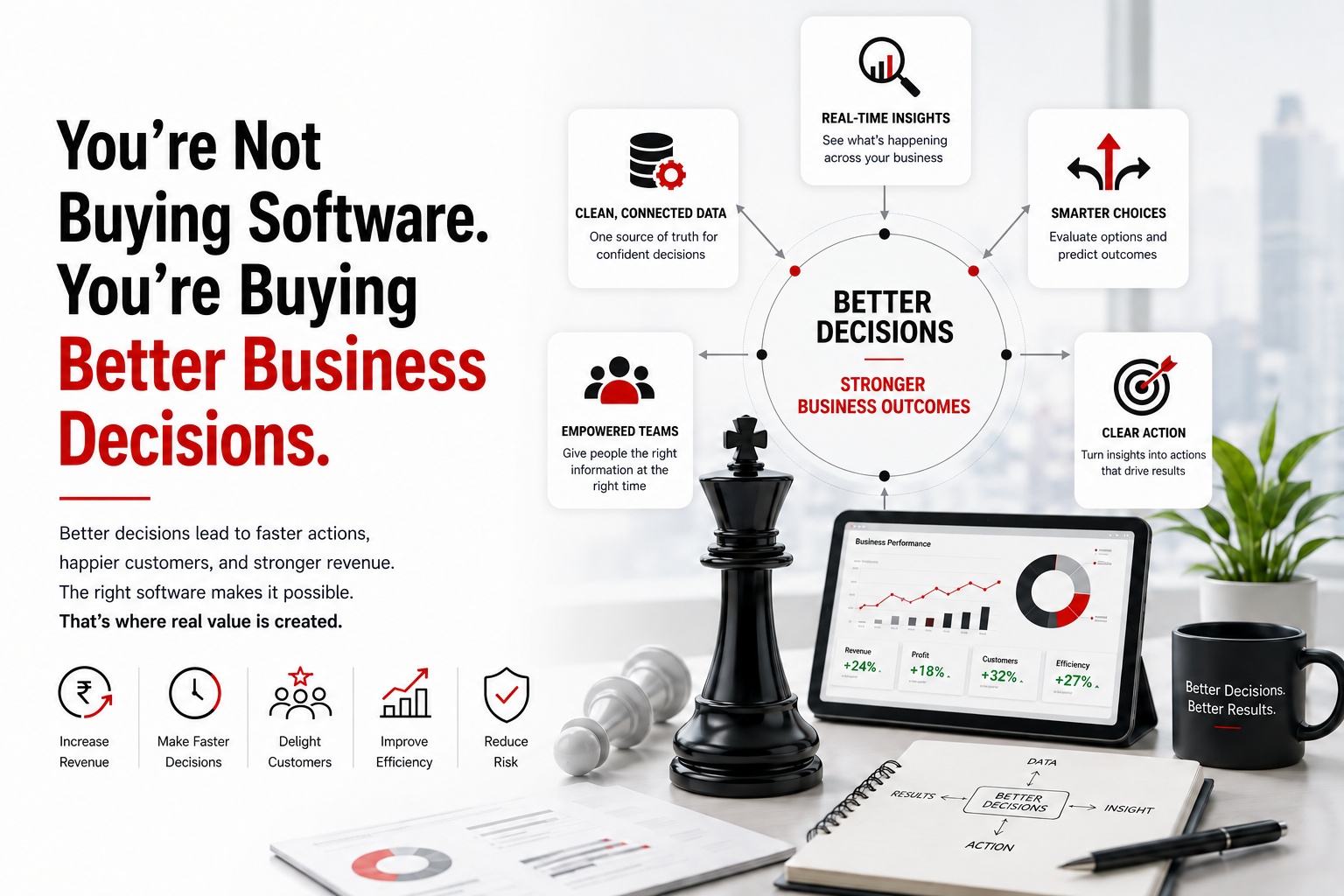
You're Not Buying Software. You're Buying Better Business Decisions
"We need new software." That was the conclusion the CEO reached after another frustrating quarterly review. Sales had slowed. Projects were delayed. Customers were complaining about slower response times. Department heads blamed outdated systems. The operations team wanted automation. Finance wanted better reporting. Marketing wanted another CRM. The IT team suggested migrating to a newer platform. Everyone agreed on one thing. The company needed new software. So they bought it. Six months later… The dashboards looked better. The interface was modern. The licensing costs had increased. Employees attended multiple training sessions. And yet… Revenue hadn't improved. Customers were still waiting. Approvals were still delayed. Managers were still asking for Excel reports. The problem wasn't the software. The problem was something much deeper. The company never had a software problem. It had a decision problem.
The Most Expensive Business Mistake Companies Still Make
Walk into almost any boardroom and ask executives: "Why are you investing in new software?" You'll hear answers like:
- We want automation.
- We need AI.
- We need better dashboards.
- Our competitors are modernising.
- Our systems are outdated.
These aren't wrong. But they aren't the real reason either. Businesses don't wake up wanting software. Nobody gets excited about buying another ERP. Nobody dreams about purchasing another CRM licence. Nobody celebrates implementing another workflow platform. What businesses actually want is something much more valuable. They want to make better decisions. Faster decisions. Smarter decisions. More profitable decisions. Software simply happens to be one of the tools that enables those decisions. And that's a fundamental difference.
The Companies Winning Today Aren't Buying More Software
They're Building Better Decision Systems. For years, organisations believed digital transformation meant purchasing new technology. Today, the conversation has changed. The companies creating the most value aren't necessarily the ones buying the newest platforms. They're the ones redesigning how decisions are made. Recent research from McKinsey found that almost 90% of business leaders expect AI to drive revenue growth over the next three years, yet nearly 70% of business transformations still fail to achieve their intended outcomes. The common challenge isn't access to technology- it's transforming the way people, processes, and decisions work together. That's an important insight. Technology isn't the bottleneck anymore. Decision-making is.
Every Business Problem Is Actually a Decision Problem
Let's simplify this. Imagine a customer places an order. Now follow that order through the organisation. Sales receives it. Operations schedules it. Inventory verifies availability. Finance approves the payment. Logistics plans the delivery. Customer support tracks progress. On paper, everything seems straightforward. But now imagine each department uses different systems. Different reports. Different spreadsheets. Different versions of the truth. Suddenly something simple becomes complicated. Not because employees aren't working hard. Because every department is making decisions using different information. The customer experiences:
- Delays.
- Confusion.
- Repeated conversations.
- Missed commitments.
Leadership experiences:
- Slower growth.
- Lower productivity.
- Reduced visibility.
Revenue quietly begins leaking away. Not through one catastrophic mistake. But through thousands of small decisions made every single day.
Revenue Doesn't Disappear Overnight
It Leaks Through Everyday Friction. Most businesses think revenue loss comes from losing customers. Sometimes it does. But more often, revenue disappears in far less obvious ways. Consider these everyday situations. A quotation reaches the customer two days late. An approval waits in someone's inbox until Monday morning. A sales representative cannot see updated inventory. Customer support asks the customer to repeat information already provided. Finance spends two days reconciling reports before month-end. None of these events individually seem significant. Collectively, they become expensive. Operational friction creates decision delays. Decision delays reduce customer experience. Poor customer experience reduces revenue. The software didn't lose the customer. The delay did.
The Hidden Cost of Slow Decisions
Imagine two companies. Both sell the same products. Both have talented employees. Both invest similar amounts in technology. Company A approves customer requests within two hours. Company B takes two days. Which company earns more repeat business? Now imagine: Company A identifies declining sales trends immediately. Company B discovers them three weeks later during monthly reporting. Which company reacts faster? Which company protects revenue? Which company grows? Competitive advantage today is rarely determined by who has more information. It's determined by who can turn information into decisions faster.
Why Data Alone Doesn't Create Value
Many organisations proudly describe themselves as "data-driven." But data by itself creates no value. A dashboard doesn't increase revenue. A report doesn't improve customer experience. A spreadsheet doesn't reduce operational costs. Value is created only when information changes a decision. Think about it. Your business probably already has plenty of data. Sales reports. Customer feedback. Marketing analytics. Financial reports. Operational dashboards. The question isn't: "Do we have enough data?" The better question is: "Can our people make better decisions because of this data?" That's where software creates its real return on investment. Not by generating information. By helping people act on it.
Why AI Isn't the Revolution Everyone Thinks It Is
Artificial Intelligence is dominating business conversations today. Every company wants AI. Every software vendor promises AI. Every product now includes AI features. But here's something fascinating. The organisations generating the greatest value from AI aren't simply deploying AI tools. They're redesigning how decisions happen inside the business. According to McKinsey, while almost 90% of leaders believe AI will contribute to revenue growth, organisations consistently underestimate the organisational change required to unlock that value. Technology is advancing rapidly, but business transformation remains the harder challenge. In other words… AI doesn't create better businesses. Better decisions create better businesses. AI simply makes those decisions faster- provided the underlying processes are already working.
Why More Software Doesn't Always Mean More Revenue
Let's return to our CEO. He bought new software. The interface improved. Reporting improved. The technology improved. But revenue didn't. Why? Because nobody asked one critical question: Which business decisions are we trying to improve? That's the question that separates successful digital transformation from expensive digital projects. Buying software because competitors have it is rarely a strategy. Buying software because it enables faster pricing decisions… Better inventory decisions… Smarter sales forecasting… Quicker customer support… Or more accurate operational planning… Now that's a business strategy. And business strategies create revenue.
Software Should Reduce Thinking- Not Increase It
The best software doesn't constantly demand attention. It quietly removes friction. Employees don't need to remember five different systems. Managers don't need to request multiple reports. Executives don't wait until month-end to understand performance. The information arrives. The insight becomes obvious. The decision becomes easier. That's what businesses are actually purchasing. Not software. Decision clarity. The Highest-Performing Companies Don't Have Better Software. They Have Better Decision Velocity. There's an interesting pattern you'll notice when studying companies that consistently outperform their competitors. It's rarely because they own dramatically better technology. Instead, they're exceptionally good at making decisions. Quickly. Confidently. And with the right information. Amazon is famous for its "one-way door" and "two-way door" decision framework, encouraging teams to make reversible decisions quickly rather than waiting for perfect information. This philosophy has helped the company maintain speed even as it scaled globally. Netflix uses real-time viewing data to influence everything from content recommendations to investment decisions. Uber adjusts pricing dynamically based on live demand and supply. These companies certainly invest in technology. But technology isn't their competitive advantage. Decision speed is. Technology simply enables it.
Every Delay Has a Revenue Cost
Let's consider a simple example. A manufacturing company receives an enquiry worth ₹25 lakh. The sales team prepares a quotation. Finance needs to approve pricing. Operations confirms production capacity. Procurement checks raw material availability. Legal reviews the contract. Each department completes its work efficiently. The problem isn't the work. The problem is the waiting. Three days become seven. Seven become twelve. Meanwhile, the customer awards the contract elsewhere. Nobody made a mistake. Yet revenue disappeared. The software didn't fail. The decision process did. Businesses often calculate the cost of software. Very few calculate the cost of delayed decisions.
The Cost of Poor Decisions Is Usually Invisible
Revenue rarely disappears because of one dramatic event. It disappears quietly. A delayed quotation. An inaccurate forecast. A missed follow-up. A customer who waits too long for support. An inventory shortage that wasn't visible in time. A pricing decision based on outdated information. Individually, each issue appears manageable. Collectively, they become a significant drag on growth. This is why operational excellence has become a boardroom priority. It's not just about efficiency. It's about protecting revenue before it's lost.
Data Doesn't Create Competitive Advantage.
Action Does. Many organisations proudly invest in dashboards. Business Intelligence platforms. Data warehouses. Analytics tools. But dashboards don't increase revenue. People do. A dashboard only becomes valuable when someone sees an insight and acts on it. Imagine two companies. Both notice that customer renewals are declining. Company A discovers the trend after the quarter ends. Company B identifies the trend within days and launches a customer retention campaign. Both had data. Only one acted quickly enough. That's the difference between collecting information and creating value.
Why Workflow Design Matters More Than Technology
Businesses often ask: "Which software should we buy?" A better question is: "How should work flow through our organisation?" Software should support that workflow- not define it. This is one of the biggest mistakes companies make during digital transformation. They purchase software first. Then try to force their teams to adapt. The most successful organisations reverse the process. They understand:
- How decisions are made.
- Where bottlenecks occur.
- Which approvals create delays.
- What information people actually need.
Only then do they design software around those realities. That's why two companies can purchase the same platform and achieve completely different results. The software isn't different. The workflows are.
Why AI Should Improve Judgment- Not Replace It
Artificial Intelligence has become the headline of almost every technology conversation. And for good reason. AI is changing how businesses analyse information, automate repetitive work, and serve customers. But here's an important distinction. The companies seeing the greatest return from AI aren't asking: "Where can we use AI?" They're asking: "Which decisions would become better if AI helped us?" That's a very different question. Research from McKinsey estimates that generative AI could contribute up to $4.4 trillion annually in productivity gains across business functions- but realizing that value depends on redesigning workflows, not simply deploying AI tools. Organizations that rethink how work is done are far more likely to capture meaningful business impact than those that treat AI as an isolated technology initiative. In other words… AI is most valuable when it helps people:
- Identify opportunities faster.
- Predict outcomes more accurately.
- Prioritize work intelligently.
- Reduce repetitive effort.
- Make confident decisions.
Technology should amplify human judgment. Not replace it.
The Real Return on Investment Isn't Software.
It's Better Decisions Made Thousands of Times Every Day. Imagine a business with 300 employees. Every employee makes dozens of decisions every day. Some are small. Some affect customers. Some influence revenue. Some determine profitability. Now imagine each employee makes just one better decision every day because they have:
- Better information.
- Better visibility.
- Better workflows.
- Better software.
That's not one improvement. That's thousands of improved decisions every month. And that's where real ROI comes from. Not from features. Not from interfaces. From cumulative business impact.
A Better Way to Evaluate Software Investments
Before investing in any new software, ask these questions. Will it help us make decisions faster?
Will it eliminate unnecessary manual work?
Will it improve collaboration between teams?
Will it reduce delays for customers?
Will it provide one trusted source of information?
Will it help leadership respond to problems earlier?
Will it create measurable business outcomes?
If the answer to most of these questions is "yes," you're probably evaluating software correctly. You're not buying technology. You're investing in decision quality.
The Companies That Win Tomorrow Are Making Better Decisions Today
Markets are changing faster than ever. Customer expectations continue to rise. Competition grows every day. In this environment, the advantage rarely belongs to the company with the largest technology budget. It belongs to the company that can:
- Understand change quickly.
- Adapt confidently.
- Empower employees.
- Remove operational friction.
- Act before competitors do.
Technology supports those capabilities. It doesn't replace them.
Coming Back to the CEO
Let's return to the story we began with. The CEO thought the company needed new software. After months of discussion, one simple question changed everything. Instead of asking: "Which software should we buy?" The leadership team asked: "Which business decisions are slowing us down?" The answers surprised everyone. It wasn't reporting. It wasn't dashboards. It wasn't the user interface. The real problems were:
- Duplicate approvals.
- Manual handoffs.
- Disconnected customer information.
- Slow communication between departments.
- Limited visibility into operations.
Only after solving those issues did they invest in software. This time, the outcome was different. Not because the technology was dramatically better. Because the decisions became dramatically better. Customer response times improved. Teams collaborated more effectively. Managers spent less time chasing information and more time solving problems. Revenue increased- not because the company purchased software, but because it removed the friction preventing people from making good decisions. That was the real transformation.
Final Thoughts
Software has never been easier to buy. Every week, a new platform promises to automate work, improve efficiency, or transform your business. But software, by itself, has never created competitive advantage. Businesses grow when people make better decisions. Faster. With confidence. Using information they trust. The best software doesn't simply automate tasks. It reduces uncertainty. It removes friction. It creates clarity. And clarity leads to better decisions. At Arodos Technologies, we believe software should never be viewed as an expense or a collection of features. It should be viewed as an investment in the quality of every decision your business makes. Because at the end of the day… You're not buying software. You're buying the ability to make better business decisions- again and again, every single day.
Ready to build software that actually solves problems?
Start a Conversation