An Executive Insight Report by Arodos Technologies
Executive Summary
Every company carefully measures employee salaries.
Finance tracks payroll.
HR measures employee performance.
Leadership reviews hiring costs.
But there's one "employee" that almost no organization measures.
It doesn't appear on payroll.
It doesn't take annual leave.
It never asks for a promotion.
Yet it quietly influences every customer interaction, every approval, every invoice, every sales opportunity, and every business decision.
That employee is your process.
The irony?
It may be costing your business significantly more than your highest-paid executive.
Most organizations believe revenue leaks through poor sales.
Some believe it leaks through rising operational costs.
Others blame market conditions.
In reality, revenue often leaks through something much quieter.
A quotation waiting for approval.
A purchase order sitting in someone's inbox.
A customer support ticket transferred between three departments.
An employee manually copying data from one system to another.
A manager waiting until the end of the month to discover a problem that started three weeks earlier.
Individually, these seem insignificant.
Collectively, they determine how fast your company grows.
This report explores a simple but powerful idea:
Your biggest business expense may not be your people. It may be the way your people work.
₹0:
The Amount Most Companies Spend Measuring Process Efficiency
Organizations invest heavily in:
- Recruiting better talent
- Employee training
- Enterprise software
- AI tools
- Business intelligence platforms
Yet very few measure one question:
How much does this process cost us every day?
The surprising part is that almost every business process has a financial impact.
Consider something as simple as approving a quotation.
If that approval takes:
- 15 minutes instead of 2,
- passes through three unnecessary reviewers,
- requires duplicate data entry,
- and delays the customer's decision by a day,
the cost isn't just employee time.
The cost is:
- slower sales,
- delayed cash flow,
- reduced customer confidence,
- and sometimes a lost opportunity.
Processes don't just consume time.
They influence revenue.
$4.4 Trillion:
The World's Biggest Productivity Opportunity Isn't More Software
According to McKinsey Global Institute, generative AI could contribute up to $4.4 trillion annually in additional productivity across corporate use cases. But there's an important detail that often gets overlooked.
Organizations that capture the most value don't simply deploy AI.
They redesign workflows first.
Technology amplifies good processes.
It rarely fixes broken ones.
Think about that.
Two companies purchase the same AI platform.
One transforms productivity.
The other barely notices a difference.
The technology is identical.
The process isn't.
That's why digital transformation should never begin with technology.
It should begin with understanding how work actually flows through the business.
23 Minutes:
The Cost of One Interruption
Research frequently cited in workplace productivity studies has shown that after an interruption, knowledge workers can take around 23 minutes to fully regain focus.
Now imagine an employee who experiences:
- approval requests,
- status update meetings,
- Slack or Teams notifications,
- emails,
- calls,
- and context switching between multiple applications.
The interruption itself lasts seconds.
The recovery takes much longer.
Now scale that across 100 employees.
Then 500.
What initially looked like a communication issue suddenly becomes a business performance issue.
Processes that constantly interrupt people don't just reduce productivity.
They reduce the quality of decisions.
Every Process Creates One of Two Outcomes
Every workflow inside your company ultimately does one of two things.
It either creates value.
Or it creates friction.
There is no neutral process.
A customer onboarding process either helps customers start quickly- or makes them reconsider.
An approval workflow either accelerates business- or delays it.
A reporting process either provides timely insights- or produces historical information that arrives too late to influence decisions.
The most successful companies understand this.
They don't optimise technology.
They optimise decision-making.
Technology simply supports it.
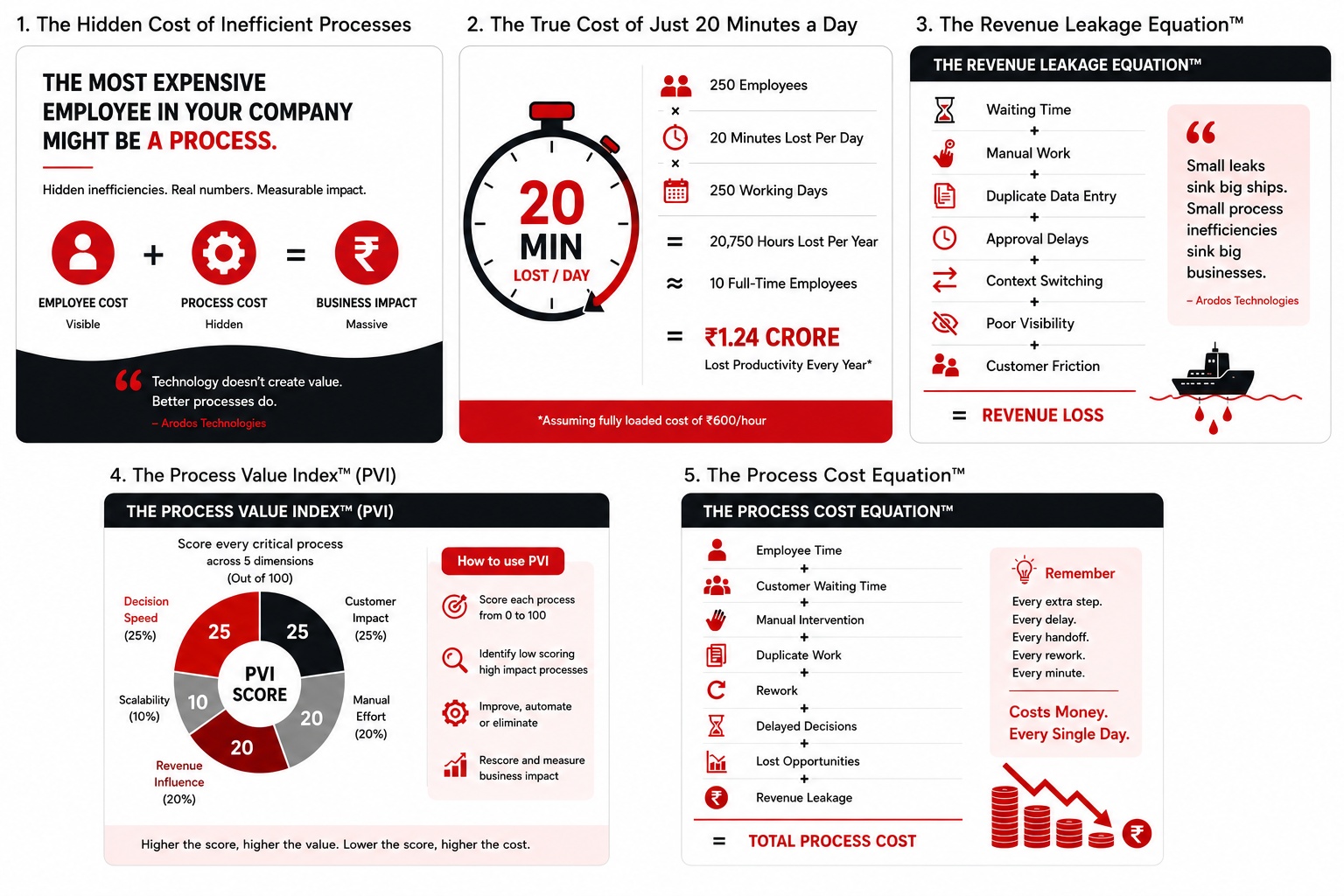
The Revenue Leakage Equation™
One of the biggest misconceptions in business is that revenue loss happens through dramatic events.
A major customer leaves.
A product fails.
A recession begins.
Those events matter.
But many organizations lose revenue in much smaller increments.
We call this Revenue Leakage.
At Arodos, we think of it like this:
The Revenue Leakage Equation™
How silent inefficiencies multiply to drain your profitability.
Leakage
Time
Work
Entry
Delays
Switching
Visibility
Systems
None of these factors seem catastrophic individually.
Together, they quietly reduce profitability every single day.
Unlike traditional financial losses, process losses are difficult to see because they occur in small amounts across hundreds of employees and thousands of daily interactions.
The Cost of Waiting
Imagine two companies.
Both manufacture the same product.
Both employ talented people.
Both invest similar amounts in technology.
Company A responds to customer enquiries within one hour.
Company B takes twenty-four hours.
Everything else is identical.
Who wins?
Speed has become a competitive advantage.
Customers increasingly judge businesses not just by quality or price- but by responsiveness.
Every hour spent waiting for an internal approval is an hour your customer may spend talking to a competitor.
Waiting isn't merely an operational issue.
It's a revenue issue.
When Processes Become Your Most Expensive Employee
Let's imagine a mid-sized company with:
Now assume each employee loses just 20 minutes per day because of inefficient workflows:
- searching for information,
- waiting for approvals,
- updating spreadsheets,
- switching between applications,
- re-entering data.
The True Cost of Inefficient Workflows
That's equivalent to more than six full-time employees worth of productive capacity.
The company didn't hire six unnecessary employees. Its processes quietly created the same financial burden.
And that's before considering the impact on customers, revenue, or decision-making.
Process Debt Is Real
Most leaders understand technical debt.
Software built quickly often becomes harder to maintain later.
Processes behave the same way.
Shortcuts become habits.
Manual approvals become policy.
Spreadsheets become systems.
Duplicate work becomes "how we've always done it."
Over time, organizations accumulate Process Debt.
Unlike financial debt, it doesn't appear on a balance sheet.
But employees pay interest on it every single day.
Every additional approval.
Every unnecessary meeting.
Every duplicate report.
Every disconnected system.
That interest compounds.
Quietly.
Until growth begins to slow.
One Question Every CEO Should Ask
Before approving the next technology investment…
Before hiring more people…
Before implementing another software platform…
Ask one simple question.
"Which process in our business is costing us the most money today?"
The answer is rarely obvious.
But it is often where the biggest opportunity for growth begins.
Processes Don't Appear on Your Balance Sheet
But They Influence Every Number On It.
Every business leader reviews financial statements.
Revenue.
Gross Margin.
Operating Costs.
EBITDA.
Cash Flow.
These numbers tell you what happened.
Processes explain why it happened.
Think about the journey of a single customer order.
It starts with Sales.
Moves to Operations.
Touches Inventory.
Requires Finance.
Ends with Customer Support.
Every department adds value.
But every handoff also introduces risk.
One delayed approval.
One manual spreadsheet.
One duplicated data entry.
One missing update.
One overlooked email.
By the time the customer notices a delay, the process has already failed in five different places.
The customer doesn't see your workflow.
They experience your process.
The 5-Minute Delay That Costs ₹5 Crore
Let's look at something simple.
Imagine a company with:
Now imagine every employee loses just 5 minutes every working day because of:
- waiting for approvals
- searching for files
- duplicate data entry
- asking for information already available elsewhere
That seems insignificant.
The Cost of "Just 5 Minutes"
How a minor delay compounds across an organization.
Now ask yourself:
Did customers wait during those hours?
Did projects get delayed?
Were sales opportunities missed?
Was management forced to make decisions using outdated information?
The actual business impact is usually much larger than the salary cost.
Decision Velocity Is Becoming the New Competitive Advantage
Twenty years ago, competitive advantage often came from:
- Better factories
- Better products
- Better pricing
Today, those advantages disappear quickly.
Technology is accessible.
Cloud infrastructure is affordable.
AI tools are becoming widely available.
The companies pulling ahead are often those that make better decisions faster.
Research from Deloitte consistently highlights that organizations able to respond quickly to changing business conditions outperform slower competitors because they adapt faster, allocate resources more effectively, and improve resilience in uncertain markets.
Speed is no longer just an operational metric.
It's a financial metric.
Every Approval Has an Opportunity Cost
Most organizations measure: Approval Time
Few measures: Approval Cost.
Imagine this situation.
A customer requests a custom quotation.
The proposal is ready within two hours.
But it requires: Sales Manager approval. Finance approval. Regional Head approval. Legal approval. Director approval.
Three working days later-
the customer chooses another vendor.
Nobody rejected the proposal.
Nobody made a mistake.
The company simply made the customer wait.
Waiting is rarely free.
It often becomes lost revenue.
Process Cost Equation™
Our Efficiency Framework
The Process Cost Equation
Cost
Time
Waiting
Intervention
Work
Required
Decisions
Opportunities
Leakage
Notice something interesting?
Technology cost doesn't even appear.
Because technology is rarely the biggest expense.
Poor execution is.
The World's Best Companies Win Because of Process Excellence
Let's leave software aside for a moment.
Instead, look at companies admired for operational excellence.
Not because they bought better software.
Because they built better systems.

Toyota transformed manufacturing through the Toyota Production System (TPS).
The philosophy wasn't:
"Build faster."
It was:
"Remove waste."
Small process improvements reduced defects, waiting, unnecessary movement, inventory waste, and production delays.
Over decades, these micro-improvements created one of the world's most efficient manufacturing systems.
Technology supported the process.
It didn't define it.

Amazon's famous "Working Backwards" approach starts with the customer- not technology.
Before building a product, teams write a mock press release describing the customer benefit.
This forces every project to answer:
"What customer problem are we solving?"
Even Amazon's one-click ordering wasn't primarily a software innovation.
It was a process innovation that dramatically reduced friction during purchasing.
Removing one step created billions in additional revenue over time.

One of the most well-known examples of operational optimization comes from UPS.
By redesigning delivery routes to minimize unnecessary left turns, UPS significantly reduced fuel consumption, idle time, and emissions while improving operational efficiency.
The lesson wasn't about navigation.
It was about process thinking.
Sometimes the biggest gains come from improving decisions rather than increasing effort.

Fashion retailer Zara became famous for its speed.
Not because it produced clothing faster than everyone else.
Because it shortened the decision cycle between:
Fast decisions enabled fast business.

Netflix constantly measures user behaviour.
What people watch.
When they stop watching.
Which recommendations perform.
Which artwork increases engagement.
The company isn't collecting data for reports.
It's collecting data to make better decisions continuously.
That's the difference.
Why Employees Don't Hate Software
They Hate Friction.
When people complain about software, they're rarely complaining about:
Buttons.
Colours.
Dashboards.
They're complaining about effort.
Employees naturally create workarounds whenever software slows them down.
That's why businesses still find:
Excel spreadsheets.
Sticky notes.
WhatsApp groups.
Personal notebooks.
Email chains.
Shadow databases.
These aren't technology problems.
They're workflow problems.
People don't reject software.
They reject unnecessary complexity.
The Process Value Index™ (PVI)
At Arodos, we believe every critical workflow should be evaluated against five dimensions.
Every process can then receive a Process Value Index score out of 100.
For example:
Purchase Approval
PVI Score
That doesn't automatically mean the process is broken.
It means it's an opportunity.
When organizations begin measuring processes this way, improvement becomes objective rather than opinion-based.
Technology Doesn't Create Value.
People Using Better Processes Do.
This is perhaps the biggest takeaway from this report.
Businesses often assume:
However, Reality is different.
Software simply enables that chain.
The ROI Equation™
Why Most Businesses Measure the Wrong Return
When companies invest in software, the first question is almost always:
"What's the ROI?"
Usually, the calculation looks something like this:
It's a logical approach.
But it's incomplete.
Because software doesn't generate returns on its own.
People do.
Processes do.
Decisions do.
At Arodos, we believe software ROI should be evaluated differently.
The Business Decision ROI Model™
Instead of asking,
"How much did the software cost?"
Ask:
Did it help us...
- Reduce decision time ?
- Improve customer response ?
- Increase employee productivity ?
- Eliminate manual work ?
- Reduce operational errors ?
- Increase revenue opportunities ?
- Improve customer retention ?
Only then should you calculate financial return.
Because businesses don't invest in software.
They invest in better business outcomes.
The Hidden Compounding Effect
Most executives understand compound interest.
Few understand compound inefficiency.
Imagine a process that wastes just 8 minutes every day.
That doesn't sound alarming.
Now multiply it by:
That single inefficient process has now consumed tens of thousands of productive hours.
The frightening part?
Nobody notices because the loss happens gradually.
It's the business equivalent of a slow leak in a pipeline.
You don't notice the missing water each day.
Until the tank is empty.
That's exactly how process inefficiencies work.
Why AI Will Never Fix A Bad Process
This is one of the biggest misconceptions in business today.
Every week another company announces:
"We're implementing AI."
That's exciting.
But here's the uncomfortable truth.
AI doesn't magically improve businesses. It accelerates whatever already exists.
If your process is excellent, AI makes it faster.
If your process is confusing, AI makes confusion happen faster.
If your approvals already take four days, AI may draft emails more quickly-
but customers are still waiting four days.
Technology amplifies systems.
It rarely redesigns them.
That's why the most successful AI projects always begin with workflow redesign- not technology deployment.
The CEO Process Audit™
Before approving your next software budget, ask your leadership team these ten questions.
Those ten questions reveal more about an organization's health than many operational dashboards.
A Simple Exercise Every Leadership Team Should Try
Choose one process. Just one.
For example:
Customer onboarding.
Write every step on a whiteboard.
Then ask: Does this create value?
Or delay value?
One by one.
You'll be surprised how many steps exist simply because:
"That's how we've always done it."
Most organizations don't need to redesign everything.
They need to remove what no longer matters.
The Businesses That Will Lead The Next Decade
Over the next ten years, every company will have access to:
Cloud infrastructure.
Artificial Intelligence.
Automation platforms.
Advanced analytics.
Enterprise software.
Technology will become increasingly accessible.
Which means technology itself will become less of a competitive advantage.
What will remain difficult to copy is:
How quickly your company learns.
How quickly it adapts.
How quickly it makes decisions.
How effectively people collaborate.
How smoothly work flows across departments.
Those capabilities aren't created by software alone.
They're created by designing better systems for people.
What This Means For Growing Businesses
If you're leading a growing business today,
don't begin your digital transformation journey by asking:
"What software should we buy?"
Begin by asking:
"Which process is preventing our people from doing their best work?"
Because once you identify that process,
everything becomes clearer.
The technology.
The Automation.
The integrations.
The AI.
The dashboards.
The software simply becomes the implementation of a much better idea.
Final Thought
Let's return to the title.
The Most Expensive Employee in Your Company Might Be a Process.
At first, it sounds provocative.
But after reading this report, it should feel logical.
Processes influence:
Every customer interaction.
Every employee.
Every approval.
Every invoice.
Every quotation.
Every support request.
Every business decision.
Unlike employees,
processes never ask for feedback.
They simply keep producing the same results- good or bad- every single day.
The good news?
Unlike market conditions, competition, or economic uncertainty, processes are entirely within your control.
Improve the process, and you improve the decisions.
Improve the decisions, and you improve the outcomes.
Improve the outcomes, and revenue follows.
That's why the smartest companies in the world don't obsess over buying more technology.
They obsess over removing friction.
Because in business, the biggest competitive advantage isn't always having smarter people.
It's helping good people make great decisions- consistently.
About Arodos Technologies
At Arodos Technologies, we don't begin software projects by discussing programming languages, frameworks, or platforms.
We begin by understanding how your business works.
Where decisions slow down.
Where teams lose time.
Where customers experience friction.
Where revenue quietly leaks.
Only then do we design technology that aligns with your business- not the other way around.
Because our goal isn't simply to build software.
It's to help businesses build better systems, empower better decisions, and create measurable business outcomes.
Executive Takeaways
Before your next technology investment, ask yourself:
If these questions aren't part of your software evaluation process today, they probably should be.